Dataset · version 1.0
Japanese Municipal Elections Dataset (JMED) 日本市区町村選挙データセット
Version 1.0 includes the near universe of candidates who ran for office in municipal assembly and mayoral elections from 2005 to 2025: 223,561 candidates in 21,111 elections across 2,027 municipalities. JMED records turnout, uncontested elections, and each candidate's name, age, sex, party, incumbency status, vote total, and outcome.
At a glance · most recent election in every municipality, 2022–2025
Click a figure to see it on the map.
Pick a municipality, see its record
Every assembly and mayoral election from 2005 to 2025: turnout, uncontested elections, and the number of candidates, plus the sex, age, party, and incumbency of the winners.
Available in English and 日本語.
Open the map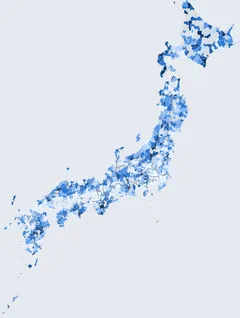
Municipal assembly and mayoral elections
Assembly members are elected by single non-transferable vote in multi-member districts. Most assembly elections use a single municipality-wide district, but some municipalities have several districts. Mayors are elected by plurality in a single municipality-wide district.
Assembly members and mayors serve four-year terms. Municipal elections were initially held nationwide in April 1947, establishing the unified local election cycle held every four years in April. Over time, resignations, assembly dissolutions, municipal mergers, disasters, and other events have shifted many elections off this cycle. Election dates therefore vary across municipalities and between offices.
Identifiers
JMED includes three unique identifiers: a candidate ID that links the same person across elections, an election ID shared by every candidate and district in an election, and a municipality ID that follows a continuing municipality across elections.
Municipal History Dataset
Between 2005 and 2025, some municipalities merged, absorbed their neighbors, split, or changed their names, government codes, or boundaries. JMED includes a companion Municipal History Dataset that records each change with its date.
Files
| File | What it is |
|---|---|
jmed_v1.0.rds | JMED in R format: 223,561 rows and 32 variables, with column types preserved. |
jmed_v1.0.csv | The same dataset as a UTF-8 CSV. Read the ID and code columns as text so leading zeros survive. |
municipal_history.rds | Municipal History Dataset in R format: 2,053 rows and 8 variables linking each municipality before a change to the municipality after it. |
municipal_history.csv | The same companion dataset as a UTF-8 CSV. |
jmed_codebook_v1.0.pdf | Variable definitions, party labels in Japanese and English, data availability by variable, sources, citations, and worked examples from the municipal history. |
README.txt | Contents and release information. |
All files are on Harvard Dataverse: doi:10.7910/DVN/E9ZUNV.
Citation and licence
Research using JMED should cite both the dataset and the article that introduces it:
McClean, Charles T. 2026. Japanese Municipal Elections Dataset (JMED). Version 1.0. https://doi.org/10.7910/DVN/E9ZUNV.
McClean, Charles T. 2026. "Does Youth Representation Matter for Social Spending?" The Journal of Politics. https://doi.org/10.1086/741605.
JMED is licensed under Creative Commons Attribution 4.0 International (CC BY 4.0). Feel free to use it for any purpose, just please cite it.
Contact
JMED is an ongoing project and will be updated regularly. Errors can be reported to jmed.data@gmail.com.
Research using JMED
JMED is at the heart of my book project, Silver Democracy, as well as several articles and a paper in progress on the politics of age and Japan:
- 2026. The Journal of Politics.
Abstract
Young people are underrepresented in most political institutions. While studies have investigated the causes behind the shortage of younger politicians, the potential consequences for the substantive representation of young people’s interests in policy outcomes remains under-researched. I argue that younger politicians will be more likely than older politicians to allocate social spending toward child welfare for young families. Using an original dataset of over 12,000 mayoral candidates in Japan (2006–2019) and a regression discontinuity design, supplemented by interviews with 15 mayors, I find that municipalities that elect younger mayors increase spending on child welfare, especially through long-term investments in infrastructure. Mechanism tests and interviews suggest these effects stem from younger mayors’ different life stages and longer time horizons rather than greater electoral incentives to court younger voters. Notably, younger mayors do not cut elderly welfare spending, suggesting youth representation can benefit young families without necessarily exacerbating intergenerational conflict over welfare.
- 2024. Political Behavior 46(4):2333-2355.
Abstract
Why do elected officials tend to be much older than most of their constituents? To understand the mechanisms behind the underrepresentation of young people in public office, we conducted two novel survey experiments in Japan. We asked voters in these experiments to evaluate the photos of hypothetical candidates while altering candidates’ faces using age regression and progression software. Contrary to the observed age demographics of politicians, the voters in our experiments strongly disliked older candidates but viewed younger and middle-aged candidates as equally favorable. Voters saw young candidates as less experienced but also more likely to focus on many policy issues over a longer period, including education, childcare, climate change, anti-corruption measures, and multiculturalism. Young voters especially liked young candidates, suggesting that greater youth turnout could increase youth representation. Conversely, elderly candidates were universally panned, seen as the least competent, least likely to focus on most policy issues, and least electable. Voter biases thus do not seem to be a driving factor behind the shortage of young politicians. To the contrary, voters appear perfectly willing to cast their ballots for young candidates.
- 2021. Nature Medicine 27(12):2111-2119.
Abstract
Among tool kits to combat the coronavirus disease 2019 (COVID-19), caused by severe acute respiratory syndrome coronavirus 2, school closures are one of the most frequent non-pharmaceutical interventions. However, school closures bring about substantial costs, such as learning loss. To date, studies have not reached a consensus about the effectiveness of these policies at mitigating community transmission, partly because they lack rigorous causal inference. Here we assess the causal effect of school closures in Japan on reducing the spread of COVID-19 in spring 2020. By matching each municipality with open schools to a municipality with closed schools that is the most similar in terms of potential confounders, we can estimate how many cases the municipality with open schools would have had if it had closed its schools. We do not find any evidence that school closures in Japan reduced the spread of COVID-19. Our null results suggest that policies on school closures should be reexamined given the potential negative consequences for children and parents.
- Assembly Size, Electoral Accountability, and Descriptive RepresentationWork in progress. Presented at the University of Tokyo, 2026.
Related datasets and resources
Other data on Japanese elections that complement JMED.